- HOME
- BI & Analytics
- Top Business Intelligence(BI) Tools to Choose in 2026
Top Business Intelligence(BI) Tools to Choose in 2026
- Last Updated : September 5, 2026
- 2.3K Views
- 7 Min Read
.jpg )
In today’s data-driven world, effective Business Intelligence (BI) tools are essential for organizations seeking fast, actionable insights. A strong BI platform should be intuitive for business users and powerful enough for analysts, enabling teams to explore data, monitor performance, and make smarter decisions.
What are business intelligence tools
Business Intelligence(BI) tools are software solutions that collect data from multiple sources, analyze and transform data into meaningful insights, and present it through intuitive dashboards and visualizations. These tools help businesses monitor metrics, track performance trends, and measures business outcomes.
Why use BI tools for your business
Modern Business Intelligence(BI) Software help businesses track performance metrics, identify trends, and uncover opportunities or inefficiencies. It offers unique strengths such as advanced data visualization, AI-driven insights, and seamless integration with other platforms.
Beyond basic reporting, modern BI tools help organizations shift from reactive analysis to proactive, insight-led decision-making. By unifying data from multiple systems into a governed, single source of truth, BI platforms reduce manual effort and ensure consistency at scale.
With self-service analytics and AI-assisted insights, teams across departments can explore data independently without overloading IT, allowing analytics adoption to scale seamlessly as the organization grows.
Benefits of using business intelligence tools
Data-Driven Decision-Making: BI tools help derive actionable insights from raw data, enabling quick and informed business decisions.
Real-Time Insights: Businesses can use BI tools to monitor key performance indicators and other relevant metrics in real time, allowing for timely and effective interventions.
Data Visualization: BI tools simplify complex data through intuitive charts, graphs, dashboards, and other visual formats.
Enhanced Collaboration: BI tools empower organizations to securely share dashboards and reports with actionable insights among relevant stakeholders.
Personalization: BI tools enable the delivery of tailored, customized views for different teams, departments, or individual roles.
How to choose the right Business Intelligence Tool
Some key aspects to consider when evaluating BI tools for your business include:
Data management and preparation - The ability to collect, cleanse, transform, and enrich data effectively
AI infused BI - The presence of generative AI capabilities like conversational assistance, automated insights, and advanced AI-powered techniques like forecasting and cluster analysis
Extensibility - The scope to create/develop custom capabilities and scale up based on business requirements
Keeping these essential capabilities in mind, here's our list of the top BI tools on the market today
"The best BI platform available on the market is Zoho Analytics, given its value for money, and integration with Zoho apps, Social Media app, Google Big Query and AWS. This made it easy for us to commit to this platform."
Glide Invest
Head of Product
Top Business Intelligence Tools in 2026
- Zoho Analytics
- Qlik
- Microsoft Power BI
- Tableau
- Sisense
1. Zoho Analytics
Zoho Analytics combines ease of use with powerful BI and analytics capabilities, making it accessible to all types of users. The platform enables seamless data collection and preparation through visual data pipelines, while an advanced metrics layer serves as a single source of truth by standardizing business metrics. GenAI features, like Ask Zia and diagnostic insights, are highly business user-friendly. Advanced capabilities like predictive AI, AutoML, and Python Code Studio cater to power users like data scientists and data engineers. The platform's sophistication and extensibility make it a solution suited for both SMBs and large enterprises.
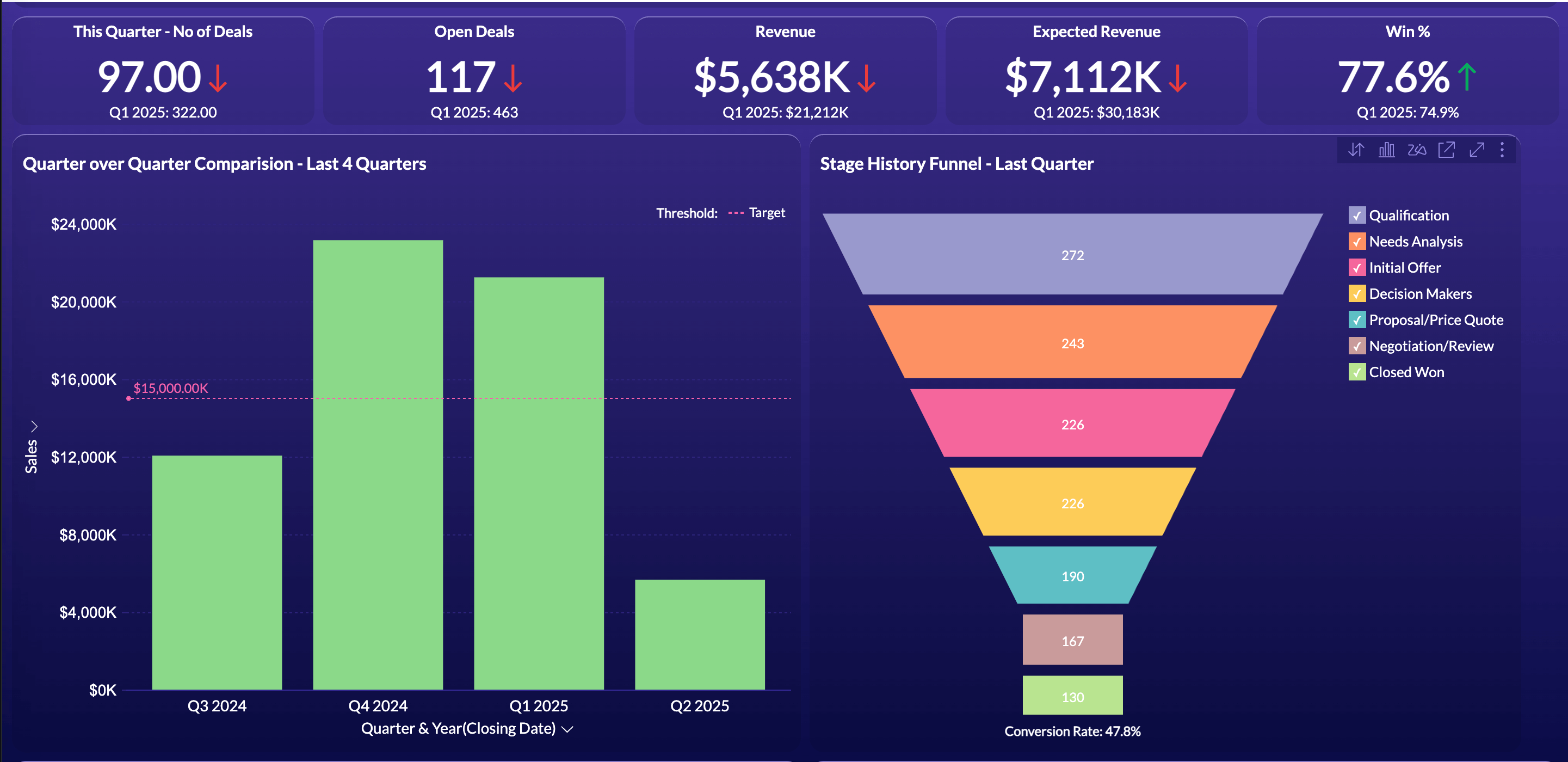
Zoho Analytics has been a game changer for us. With near real-time reports, we can slice and dice data without relying on spreadsheets. Our business leaders can now monitor performance and view our credit control and debtor positions instantly instead of waiting until month-end.
- Paul Cogger
Financial Controller, Arrow Risk Management
2. Qlik
Qlik is known for its unique associative data model that fundamentally transforms how users interact with their data, allowing business users to deal with a diverse variety of data sources. Qlik’s associative analytics engine lets users freely explore data relationships and uncover hidden insights, and the platform's AI-driven Insights Advisor caters to both data-savvy and business users. Their support for embedding and extensibility has made Qlik a viable option for embedded analytics.
3. Microsoft Power BI
Power BI's interactive features allow business users to gather detailed insights. The incorporation of AI-driven analytics, like Q&A insights and predictive modeling, empowers users to perform deeper data analysis. With an evolving feature set and deep native integration with Microsoft's productivity suite, Power BI is a favorite of organizations that are already part of the Microsoft ecosystem.
Deciding between Power BI and Tableau is one of the most common evaluation dilemmas in BI. If that's where you are, our Power BI vs Tableau head-to-head comparison breaks down pricing, features, and use cases side by side.
4. Tableau
Tableau supports responsive and adaptive dashboards. It offers a collaborative data space that enables comment threads, custom alerts, real-time data layering, and streamlined workflows. Tableau's strength lies in how users of all skill levels can not only explore data but also communicate impactful data stories.
5. Sisense
Sisense provides a flexible data fabric that connects disparate sources. It facilitates collaboration by providing actionable insights with in-context analytics, and the platform's robust architecture is designed to handle enterprise-grade needs at scale. The support to embed BI directly within other products and business workflows makes Sisense appealing for organizations looking to make data an integral part of their customer experience.
Comparison of Top BI Tools
| Zoho Analytics | Tableau | Power BI | Qlik | Sisense | |
| Data Integration | 500+ data connectors | 100+ connectors | 400+ connectors | 100+ connectors | 400+ connectors |
| Native Data Preparation | Zoho DataPrep | Tableau Prep | Power Query | Qlik Replicate | Available |
| Visual Data Pipelines | Yes | Yes | Yes | Yes | Yes |
| Metrics Layer | Yes | Yes | Yes | No | Yes |
| Pre-built analytics | In-depth for 100+ business applications | Limited | Limited | Limited | Limited |
| Visual analysis | 50+ chart types supported | 24+ charts | 40+ charts | 15+ charts | 35+ charts |
| Generative AI |
|
|
|
|
|
| Predictive AI |
|
|
|
|
|
Data Science
| Auto ML, Custom ML model building | Supported via third-party extensions | Auto ML, Custom ML model building | Auto ML, Custom ML via third-party support | Auto ML, Custom ML model building |
| Data Storytelling | Supports embeddable presentation creator, custom portals and automated Zia Insights (in multiple languages) | Presentations, custom portals and automated insights (partner-powered) | Presentations, custom portals and automated insights | Presentations, custom portals and automated insights (partner-powered) | Supports presentations and automated insights with Sisense narratives |
| BI Fabric | Yes | No | No | No | No |
| API Support | Extensive | Extensive | Available | Available | Available |
| Security & Privacy | ISO/IEC 27001, 27017, 27018 SOC 2 Type 2, GDPR, HIPAA | ISO/IEC 27001, 27017, 27018 SOC 2 Type 2, GDPR, HIPAA | ISO/IEC 27001, 27017, 27018 SOC 2 Type 2, GDPR, HIPAA | ISO/IEC 27001, 27017, 27018 SOC 2 Type 2, GDPR, HIPAA | ISO 27001, 27017, 27108, SOC 2 Type II, HIPAA |
| Single User Interface | Single interface for data integration & preparation, data science, analysis & collaboration | Not Available | Not Available | Not Available | Not Available |
| Pricing | Cloud: Starts at at $8/user/month
On-premise: Starts at $45 for 5 users/month | Cloud & On-premise: Starts at $75/user/month | Cloud: Starts at $14/user/month On-premise: Starts at $4995/capacity/month | Cloud: Starts at $41/user/month On-premise: Pricing on request | Cloud: Pricing on demand (Approximately $21000 per year for minimum 5 users)
On-premise:Pricing on demand (Approximately $10000 per year for minimum 5 users) |
Selecting the right BI tool in 2026 boils down to your organization’s specific needs, from ease of use and AI features to integration, scalability, and collaboration. It's worth noting that Power BI, despite its strengths, has well-documented limitations around pricing complexity and ecosystem lock-in that teams should weigh carefully. The tools listed above are among the most capable options available today, each offering its own strengths for driving data-driven success.
This list might not be exhaustive, but it's a good start if you're seriously looking for a BI/analytics tool.
Why Zoho Analytics is the best BI tool in 2026?
As evident from the comparison table above, Zoho Analytics offers an extensive range of BI and analytics capabilities, on par with other leading BI tools in the market.
However, there are several areas where Zoho Analytics truly stands out, making it a compelling choice for businesses seeking a robust BI solution:
500+ data connectors supporting files & feeds, local/cloud databases, and popular business applications
Extensive, in-depth pre-built analytics for faster time-to-insight
A wide range of visualization options to represent data intuitively
A single unified interface for all essential BI capabilities—data prep, reporting, AI insights, and more
Deeper AI infusion across all layers of the BI stack, enhancing automation and decision-making
Extensive support for Embedded BI
And if you're willing to consider Zoho Analytics, you can get started here. Also, we can offer you a personalized demo at your convenience.
Wishing you a happy BI journey!
Frequently Asked Questions
Which BI tool has strong row-level security for a small business?
Zoho Analytics has a strong row-level security. It restricts data by user or role, so a 10-person team can share one dashboard where each person sees only their own region or accounts.
Which BI tools integrate machine learning for analysis?
Zoho Analytics includes built-in machine learning for forecasting, anomaly detection, and clustering, without requiring a separate data science tool. You can also plug in custom ML models through its API if you need something beyond the built-in options.
What's the best software for advanced business intelligence?
Among advanced BI platforms, Zoho Analytics stands out for combining self-service reporting, AI-assisted queries, and built-in machine learning in one product rather than requiring separate add-ons. Compare it against Power BI and Looker based on your team's existing data stack.
Which business intelligence tools have the best real-time data capabilities?
Real-time BI matters when decisions can't wait for an overnight batch refresh. Zoho Analytics supports live connections and streaming data for use cases like operations monitoring, refreshing dashboards continuously instead of on a fixed daily or hourly schedule.
What are the best platforms for unified business intelligence and analytics?
For unified business intelligence the best platform is Zoho Analytics as it ranks on top for its ad hoc analysis, and predictive modeling in one platform instead of stitching together separate tools.
 Ezra
EzraA storyteller with a passion for exploring and discussing everything related to data.