Payroll fiscal year in India: A practical guide for HR teams in India
- Last Updated : March 18, 2026
- 237 Views
- 4 Min Read


April signals a crucial reset for HR teams in India as they start the new payroll cycle. From recalculating taxes and updating compliance records to verifying employee declarations, HR teams are exceptionally busy during this time. They work diligently to ensure payroll calculations are accurate, error-free, and compliant for the coming year. If you're an HR professional prepping for the payroll fiscal year, we're outlining the essential steps for managing tax declarations, compliance, deduction limits, and more.
What is the payroll fiscal year in India?
In the realm of payroll and finance, a fiscal year is a 12-month window that organizations use for financial reporting, budgeting, statutory filings, and income tax calculations. While the normal calendar year spans from January 1 to December 31, the fiscal year in India runs from April 1 to March 31. Since payroll is closely tied to finance, taxation, and compliance, it aligns with the fiscal year, too. Throughout the fiscal year, organizations usually track and manage different payroll elements, including employee income, provident fund contributions, professional tax, investment proofs, and Form 16 generation.
What are the key payroll activities and compliance requirements at the start of a fiscal year in India?
At the start of the fiscal year, HR and finance teams systematically review payroll processes, tax calculations, and compliance frameworks to ensure accurate payroll processing throughout the year. Key activities during this period include the following:
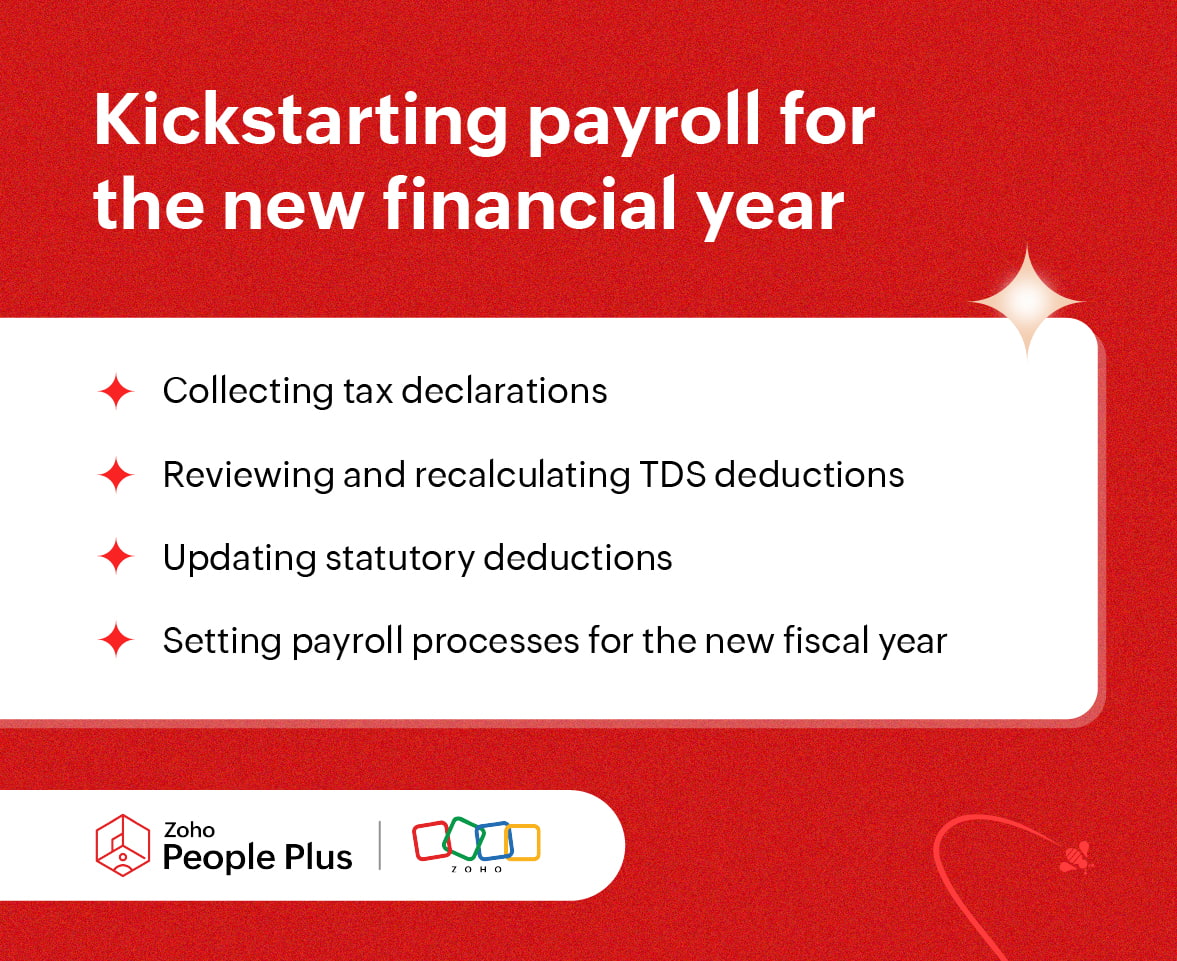
Collecting tax declarations
With the start of the fiscal year, HR and payroll teams usually reach out to employees to declare the list of tax-saving investments they have in place, like housing loans, mediclaim premiums, insurance premiums, provident fund contributions, and more. This will help them calculate the exact amount of tax that needs to be deducted from employees' salaries.
Reviewing and recalculating TDS deductions
Using the inputs they receive on investment declarations and the expected employee salary, payroll teams usually calculate the total amount of tax that employees need to pay. This tax liability is spread across the 12 months in the fiscal year and is deducted every month. This way, employees don't have to pay a large tax amount at the end of the year. For instance, if an employee has to pay a tax amount of Rs. 1,20,000, then Rs. 10,000 will be deducted as TDS every month.
Updating statutory deductions
The government requires organizations to deduct certain amounts from employee salaries towards taxes, retirement benefits, insurance, and social security schemes. Some common statutory deductions in India usually include Employee Provident Fund, Professional Tax, and Employee State Insurance, to name a few.
For instance, if an employee is eligible for Provident Fund (PF), the employer must deduct 12% of the employee's basic salary as the employee's PF contribution. The employer should also contribute an additional 12% towards the PF.
So, if an employee's basic salary is Rs. 50,000, the employer has to deduct Rs. 6,000 (12%) from the employee's salary and also contribute Rs. 6000 as the employer's share to the PF.
Setting payroll processes for the new fiscal year
As the new fiscal year starts, employers should review their payroll processes to ensure that they reflect the latest salary structure norms, tax rules, statutory deductions, and filing rules. If your organization processes hikes during April, then you'll have to update your new salary structure in your payroll process so that taxes and deductions are calculated correctly for the rest of the fiscal year. Additionally, review income tax slabs, standard deductions, professional tax rules, and surcharge rules.
How can HR teams start the payroll fiscal year effectively?
Here are some best practices that your team can adopt to set up your payroll processes for success:
Set up a payroll calendar
Map out all of your payroll activities in a calendar so that you don't miss out on any key payroll deadlines. Lay out the work period and salary payout. Set clear timelines for collecting attendance data, leave data, timesheet data, and reimbursement details. Similarly, set clear dates for payroll processing, verification, and salary disbursement. Don't forget statutory deadlines like PF contribution, ESI contribution, TDS deposit, quarterly TDS returns, and Annual form.
Keep employees informed
Some of your employees may not have a clear idea about the different components in their salary structure. That's why it's good to conduct payroll awareness sessions at the beginning of the fiscal year to help them understand how payroll calculation, tax deductions, and other statutory components work.
Review employee records
As you start, it's also good to review employee payroll-related records, including name, address, salary account details, PAN details, compensation data, and tax regime selection, to make sure everything is error-free when calculating salaries, applying deductions, and ensuring compliance.
Streamline tax declarations
Encourage your employees to declare their tax-saving investment details as early as possible to ensure that their tax liabilities are calculated accurately, and you don't have to make large tax adjustments when the fiscal year ends. This way, even your employees don't have to manage sudden increases in TDS deductions during the final months.
Keep payroll data safe
Review all the controls you have in place to protect your payroll information. Make sure only individuals with authorized permissions have access to the data, and use encryption to keep key information secured. Share payroll information like payslips, salary information, and more through protected emails, or set up two-factor authentication to provide access to payroll-related portals.
How can Zoho People Plus help?
Zoho People Plus, our unified human capital management (HCM) system, comes with an intuitive payroll management system that makes payroll processing simple, accurate, and error-free. Your entire payroll process can be set up to align with your payroll policies and the payroll laws in your region. This way, you can automatically calculate Provident Fund, professional tax, income tax, and other deductions without any errors. Through the self-service portal, employees can submit their reimbursement claims, investment declarations along with proofs, and other documents seamlessly. The system comes with robust privacy and security measures like role-based access, password-protected payroll documents, easy data backup, and more to keep payroll data secure.