

- HOME
- Revenue Recognition
- Common revenue recognition mistakes that lead to compliance risks
Common revenue recognition mistakes that lead to compliance risks
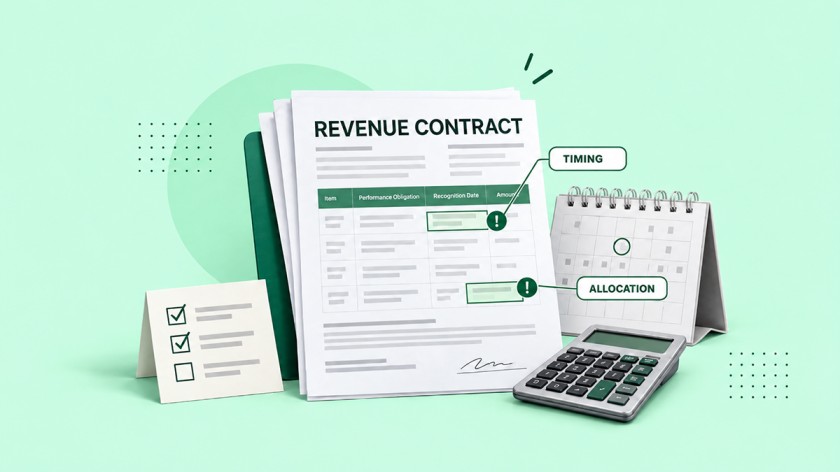
Revenue recognition mistakes rarely show up as one big event. They often build up slowly over time. Like small cracks in a foundation, they can be easy to overlook at first. But as transactions increase, contracts become more complex, and the business scales, those cracks can widen affecting everything from financial reporting to forecasting and compliance. A spreadsheet formula that doesn't account for a contract modification, an advance payment marked as revenue the moment money enters the bank account, a bundled deal that gets treated as a single line item, and similar incidents are all small oversights that collectively pose a threat significant enough to note.
Under IFRS 15, ASC 606 and all the other regional variants, the standard is straightforward and regulates how revenue needs to be recognized. Although it's simple on paper, businesses run into trouble in the day-to-day application of this. Here are the most common mistakes and why they matter.
1. Recognizing revenue when the invoice is raised, not when the obligation is satisfied
This is the most common starting point of compliance issues. Invoicing and revenue recognition are two distinct events. Combining them is a problem. Raising an invoice or getting paid is not the same as revenue hitting financial statements.
Under IFRS 15, revenue should be recognized only when the control of the goods or services is transferred to the customer and not when the invoice is sent or payment is received. An annual subscription with the invoice paid upfront should not be recognized completely on Day 1. It needs to be recognized proportionately over the entire term, with the unearned portion sitting as deferred revenue on the balance sheet.
2. Treating a bundled contract as a single performance obligation
More often than not, a deal will have multiple line items in it. This is more common in SaaS and subscription businesses. The invoice mentions annual software license, onboarding, and premium support bundled together as one cost. The problem happens when revenue is recognized for all these items simultaneously without unbundling it.
If onboarding and support are distinct, they need to be seen as individual performance obligations. Their transaction prices should be allocated based on their standalone selling price. Mixing everything together leads to revenue being bloated in the initial month and misstates how much has actually been earned at any point in time.
3. Not re-estimating variable consideration
Variable consideration is the part of payment that can change. It mostly covers discounts, rebates, usage based fees, performance bonus, and the likes of others. As these are variable components in the overall amount, it is imperative that they are estimated and reassessed during the entire contract term. Many companies do this only as a one-time exercise at the beginning.
A business that locks in the initial quote at the contract signing phase risks misstating the revenue as the usage or performance varies during the term. IFRS 15 pushes for ongoing reassessment either using the expected value method or the most likely amount method, whichever is more accurate.
4. Mishandling contract modifications
Contracts aren't written in stone. A customer may request new products or services, modify the number of users, upgrade to a better plan, or even renegotiate pricing. All these modifications to the contract can affect when and how revenue is recognized. Treating every modification as a simple update to the existing contract can lead to incorrect revenue recognition.
Depending on the type of modification, it may need to be accounted for as a separate contract, a termination of the existing contract and creation of a new one, or a modification of the existing contract. Getting this wrong can easily over or under-report revenue. For businesses with frequent upgrades, add-ons, renewals, or contract amendments, these errors can accumulate quickly, making financial reporting and audits considerably more complicated.
5. Relying on spreadsheets for deferred revenue tracking at scale
Spreadsheets work well for tracking deferred revenue when transaction volumes are low and revenue schedules are relatively simple. They have a higher tendency to break down as the volume of contracts goes up. Managing hundreds and thousands of subscriptions with different usage terms is close to impossible. Manual updates and complex formulas increase the risk of errors, and missed entries lead to incorrect revenue reporting. These errors may be individually small, but they can build up across accounting periods leading to reconciliations and audit issues.
6. Applying the same recognition pattern to every contract
It's easy to standardize the process, but not all revenue should be recognized the same way. A business may have one-time services recognized when delivered, subscriptions that are recognized over time, a usage-based model that varies monthly, or even scenarios where payments are tied to milestone completions. Applying a standard recognition pattern across all these arrangements may be convenient, but it can result in revenue being recognized too early or too late. One size fits all approach never works as the business evolves. A business that has different pricing models and contract structures must have appropriate revenue recognition schedules based on when obligations are delivered and control is transferred.
7. Booking non-refundable fees as immediate revenue
Implementation fees, set-up fees, and onboarding fees are mostly non-refundable for all businesses. This leads some businesses to assume this revenue as earned once they collect payments. But in reality, non-refundable doesn't mean it can be immediately earned. If the fee relates to a service that's part of an ongoing performance obligation (like software license), it typically needs to be recognized over the same period as the performance obligation.
8. Not keeping an audit trail for judgment calls
Revenue recognition calculations aren't straightforward. There is judgment at play, determining whether a performance obligation is distinct, estimating variable consideration, deciding how to allocate the transaction price, or assessing when an obligation has been satisfied. When taking these calls, it's better to have them documented properly.
This becomes beneficial during audits and periodic reviews. Without a clear audit trail, finance teams trace the path behind past decisions purely on guesswork. Maintaining a clear documentation of assumptions, approvals, contract changes, and recognition decisions makes these reviews easier.
Why these mistakes are so easy to make at scale
These mistakes don't happen because finance teams don't understand the revenue recognition standard. They happen because applying them consistently, contract by contract, month after month, becomes incredibly difficult as the transaction volume goes up. A single contract reported incorrectly doesn't matter much on its own. But when this is replicated across hundreds and thousands of contracts, that creates a huge gap between the revenue that is reported and the revenue that is actually earned.
This is where billing platforms with built-in revenue recognition can make a difference. Zoho Billing automatically unbundles multi-element contracts based on standalone selling prices, recalculates transaction values as usage or requirements change, and handles prospective or retrospective revenue allocation for upgrades and downgrades based on the pro-rated amount—with a full audit trail behind every recognition decision. If you want to see how it fits into your existing billing process, you can get in touch with our team for an exclusive demo of Zoho Billing.
Frequently Asked Questions (FAQs)
Just because a customer can't get their money back doesn't mean the business has actually delivered what that fee was paying for. If the fee is tied to something that unfolds over time, like a software license or an ongoing service, it needs to be recognized gradually across that same period, not all at once just because it happens to be non-refundable.
No, it depends on the specifics of the change. Depending on what's being added or changed, it might be treated as a completely separate contract, or simply as a modification to the existing one, depending on the magnitude of the changes in performance obligations.
Different types of work get delivered to the customer in different ways—some all at once, some gradually over months, and some tied to specific milestones or usage. Using one standard method across all of them means some revenue ends up being recognized too early and some too late, since the method wouldn't actually match how value is really being delivered. That being said, the same recognition method "should" be followed by the deals that belong to the same contracts.
When an auditor or reviewer later asks why a particular number was recognized a certain way, without documentation, the team has to reconstruct the reasoning from memory. This makes audits slower, harder to defend, and increases the chance that inconsistent judgment calls go unnoticed until they've already piled up across many contracts.