

- HOME
- Taxes & compliance
- MTD for Income Tax exemptions: Who is exempt and how to apply
MTD for Income Tax exemptions: Who is exempt and how to apply
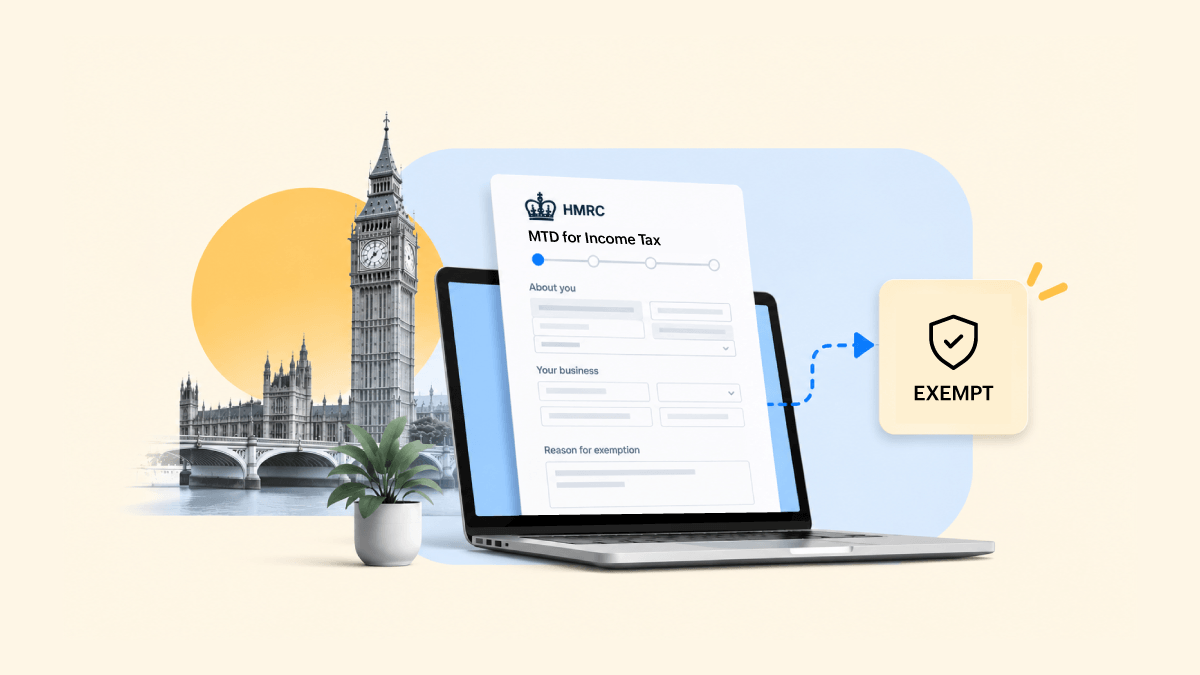
Making Tax Digital for Income Tax (MTD for Income Tax) is one of the biggest revamps to the UK tax system. It is designed to replace the traditional annual SelfAssessment tax return with digital recordkeeping and quarterly submissions to streamline reporting and reduce errors.
However, HM Revenue & Customs (HMRC) recognises that the digital mandate simply might not be for everyone. There are certain sole traders, landlords, and entity types that are exempt from complying with MTD for Income Tax.
If you're exempt from MTD for Income Tax, you can continue to report your income and gains through a Self Assessment tax return as usual.
Whether you are looking to see if your business qualifies for an exemption or just trying to plan ahead, here is a complete breakdown of who doesn't need to comply with MTD for Income Tax and why.
Types of exemptions
Automatic exemptions: These are given by HMRC based on the information HRMC holds so you do not need to contact HMRC or submit an application.
Exemptions you need to apply for: You need to provide additional information with your application to HMRC on why you think you should be exempt.
Automatic exemptions
Business structure
Not all business structures fall under the scope of MTD for Income Tax. MTD for Income Tax is strictly targeted at individual sole traders and landlords reporting self-employment or property income.
Limited companies: Corporations are governed by Corporation Tax rules, not Income Tax, and are completely outside the scope of MTD for Income Tax.
Partnerships: General and Limited Liability Partnerships (LLPs) are not currently required to join MTD for Income Tax.
Role-based
You might be responsible for submitting a tax return on behalf of entities such as a trust. Trusts submitting SA900 returns (including charitable trusts or trusts of non-registered pension schemes) are exempt.
If you are personal representative of someone who has passed away, you also automatically exempt for MTD for Income Tax.
Non-resident companies submitting SA700 are also exempt.
Income threshold
Your eligibility for MTD for Income Tax is decided by your qualifying income, which refers to your total gross income from self-employment and property combined, before deducting expenses. HMRC has phased the rollout based on revenue to ease the administrative load on smaller businesses and lower earners.
If your total qualifying gross income is £20,000 or less, you are automatically exempt and will not need to sign up for MTD for Income Tax.
No national insurance number
You are automatically exempt if you do not have a National Insurance Number before the start of the relevant tax year.
For example, if you have received your National Insurance Number on 30 April 2026 and your qualifying income was over £50,000 for the 2024 to 2025 tax year, you will be exempt from using Making Tax Digital for Income Tax for the 2026 to 2027 tax year.
Other exemptions
HMRC also outlines specific circumstances where individuals are granted temporary or practical exemptions.
Specific relief claims: Temporary exemptions apply until April 2027 for individuals making specific tax claims, such as foster carers relying solely on qualifying care relief, farmers, market gardeners, or someone who personally creates literary or art works claiming averaging relief on SA103 supplementary pages.
Lloyd's member: If you included the SA103L supplementary page as a Lloyd's member in your 2024/2025 tax return, you are automatically exempted from MTD for Income Tax.
To know more about other available exemptions, please refer to HMRC's official website.
Exemptions you need to apply for
"Digital exclusion" exemption
HMRC provides an exemption category for individuals who are "digitally excluded." This applies when it is not reasonably practical for you to keep digital records or submit updates online using compatible software.
Unlike income thresholds, digital exclusion is not automatic. You must apply directly to HMRC with supporting evidence.
Key reasons for digital exclusion
Age, disability, or health conditions: Physical or mental health conditions, or age-related limitations that prevent you from using digital devices or software.
Remote location: Living or working in a geographic area with no reliable internet access at home or your business premises.
Religious beliefs: Membership in a religious group whose core beliefs forbid the use of electronic communications or digital devices.
What doesn't count as an exemption
Many business owners assume certain common challenges will qualify them for an exemption, but HMRC maintains a strict stance. You will not be granted an exemption simply because:
You find software expensive or inconvenient.
You prefer paper-based bookkeeping.
You lack confidence with technology.
You employ an accountant to handle your taxes (HMRC expects your representative to use MTD-compliant tools).
How to apply if you qualify
If you believe you meet the criteria for digital exclusion, you must apply to HMRC by phone or in writing. Be prepared to explain your circumstances clearly and provide medical notes, location data, or relevant documentation where necessary.
If granted, you can continue filing your taxes via the traditional annual SelfAssessment return. If rejected, you retain the right to appeal within 30 days.
How Zoho Books can support you
If you fall under income threshold exemptions or if your business situation changes, you may need software at a later stage, Zoho Books offers MTD compliance at zero cost.
Zoho Books is free for sole traders and landlords covering end-to-end MTD for Income Tax compliance. From maintaining digital records, submitting quarterly updates, and final declaration submission directly to HMRC, you can do it all with Zoho Books.
You can also file your Self Assessment tax return (SA100) to HMRC through the Zoho Books free plan.